
Insights

Beyond the Limits: Navigating Direct, Backdoor, and Mega Backdoor Roth IRAs

Beyond the Limits: Navigating Direct, Backdoor, and Mega Backdoor Roth IRAs

Topic(s):

When it comes to retirement accounts, the Roth IRA is widely considered the holy grail of tax efficiency. Because you fund a Roth IRA with after-tax dollars, all future growth and qualified withdrawals are completely tax-free. Furthermore, unlike Traditional IRAs or 401(k)s, original owners of Roth IRAs are not forced to take Required Minimum Distributions (RMDs) during their lifetimes, making it a phenomenal tool for both tax flexibility and legacy planning.

Naturally, because the tax benefits are so generous, the IRS places strict limits on who can contribute directly to a Roth IRA and how much they can put in.

However, just because you earn too much to walk through the “front door” does not mean you are locked out of the Roth universe. At Suttle Crossland Wealth Advisors, we regularly help high-income earners utilize alternative strategies to build their tax-free buckets.

Here is a breakdown of the three primary ways to get money into a Roth IRA, how they work, and the hidden tax traps to watch out for.

1. Direct Roth IRA Contributions

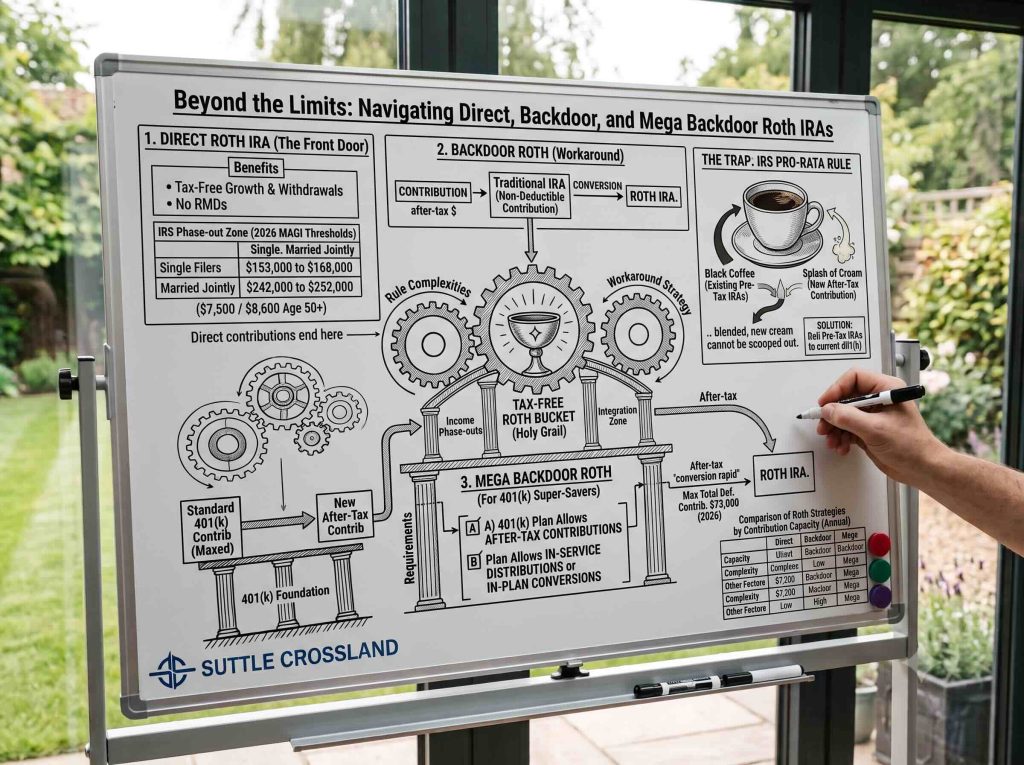
The simplest way to fund a Roth IRA is to make a direct contribution. You transfer cash from your bank account to your Roth IRA, invest it, and let it grow. For 2026, the standard contribution limit is $7,500, or $8,600 if you are age 50 or older.

The Catch: The IRS limits who is allowed to contribute based on income.

If your Modified Adjusted Gross Income (MAGI) exceeds certain thresholds, your ability to make direct contributions begins to phase out and eventually drops to zero. For 2026, the phase-out ranges are:

  • Single Filers: $153,000 to $168,000
  • Married Filing Jointly: $242,000 to $252,000

If your income is above these upper limits, direct contributions are officially off the table.

2. The Backdoor Roth IRA

If your income is too high to make a direct Roth IRA contribution, the “Backdoor Roth” strategy offers a perfectly legal workaround to get that $7,500 (or $8,600) into a tax-free environment.

The strategy takes advantage of the fact that while the IRS limits who can contribute directly to a Roth IRA, there are currently no income limits on who can convert money from a Traditional IRA to a Roth IRA.

How it works in two steps:

  1. The Contribution: You make a “non-deductible” contribution to a Traditional IRA. Because your income is high, you do not get a tax deduction for this contribution, meaning the money has already been taxed.
  2. The Conversion: Shortly after the funds settle in the Traditional IRA, you convert that exact amount into your Roth IRA.

Since you already paid taxes on the money before putting it into the Traditional IRA, and it hasn’t had time to generate any significant earnings, the conversion to the Roth IRA is a largely tax-free event.

The Trap: The IRS Pro-Rata Rule

The Backdoor Roth sounds simple enough, but it comes with a major caveat known as the Pro-Rata Rule.

If you have any existing pre-tax money in any Traditional, SEP, or SIMPLE IRA under your name, the IRS will not allow you to only convert your new, non-deductible (after-tax) contribution. Instead, the IRS views all of your IRAs as one giant bucket.

Think of it like a cup of coffee. Your existing pre-tax IRA balances are the black coffee. Your new, after-tax contribution is a splash of cream. Once you pour the cream into the coffee, you cannot scoop just the cream back out. It is blended.

If 90% of your total IRA balances are pre-tax and 10% are after-tax, then any conversion you make will be considered 90% taxable. This can create an unexpected and frustrating tax bill.

The Solution: To execute a clean Backdoor Roth, your pre-tax IRA balances need to be zero by December 31st of the year you do the conversion. A common strategy to achieve this is rolling your existing pre-tax IRAs into your current employer’s 401(k) plan (which does not count toward the Pro-Rata rule calculation) before executing the backdoor strategy.

3. The Mega Backdoor Roth

If the standard Backdoor Roth is a helpful workaround, the “Mega Backdoor Roth” is a supercharged tax strategy for super-savers. While standard IRA contribution limits are capped at a few thousand dollars, the Mega Backdoor Roth can potentially allow you to move tens of thousands of dollars into a Roth account in a single year.

The Catch: This strategy relies entirely on your employer’s 401(k) plan rules. Not all 401(k) plans allow it.

To execute a Mega Backdoor Roth, your employer’s 401(k) plan must allow two specific things:

  1. After-Tax Contributions: This is different from a traditional pre-tax contribution or a standard Roth 401(k) contribution. It is a specific bucket within the plan that allows you to contribute beyond the standard $24,500 employee deferral limit, all the way up to the IRS overall defined contribution limit for the year (which is a massive $72,000 for 2026, excluding age-50+ catch-ups).
  2. In-Service Distributions or In-Plan Conversions: The plan must allow you to move those after-tax contributions out of the 401(k) into a Roth IRA, or convert them into the Roth bucket within the 401(k) plan itself, while you are still employed.

How it works: After maxing out your standard 401(k) contributions for the year, you continue funneling money into the 401(k) as after-tax contributions. Then, you immediately convert those after-tax dollars to Roth. Like the standard backdoor strategy, doing this quickly means there are minimal earnings, making the conversion virtually tax-free. Once inside the Roth environment, that massive capital injection grows completely tax-free for the rest of your life.

The Bottom Line

Building tax-free wealth is one of the most effective ways to protect your long-term purchasing power in retirement. However, the rules surrounding Roth contributions, conversions, and employer plans are complex, and mistakes can trigger unnecessary tax liabilities.

At Suttle Crossland Wealth Advisors, we specialize in helping high-net-worth individuals and business owners navigate the intricacies of the tax code. If you are a high earner wondering how to optimize your tax buckets and whether a Backdoor or Mega Backdoor Roth makes sense for your financial plan, contact our Scottsdale team today. We can help you find the right strategy for your retirement plan.

When it comes to retirement accounts, the Roth IRA is widely considered the holy grail of tax efficiency. Because you fund a Roth IRA with after-tax dollars, all future growth and qualified withdrawals are completely tax-free. Furthermore, unlike Traditional IRAs or 401(k)s, original owners of Roth IRAs are not forced to take Required Minimum Distributions (RMDs) during their lifetimes, making it a phenomenal tool for both tax flexibility and legacy planning.

Naturally, because the tax benefits are so generous, the IRS places strict limits on who can contribute directly to a Roth IRA and how much they can put in.

However, just because you earn too much to walk through the “front door” does not mean you are locked out of the Roth universe. At Suttle Crossland Wealth Advisors, we regularly help high-income earners utilize alternative strategies to build their tax-free buckets.

Here is a breakdown of the three primary ways to get money into a Roth IRA, how they work, and the hidden tax traps to watch out for.

1. Direct Roth IRA Contributions

The simplest way to fund a Roth IRA is to make a direct contribution. You transfer cash from your bank account to your Roth IRA, invest it, and let it grow. For 2026, the standard contribution limit is $7,500, or $8,600 if you are age 50 or older.

The Catch: The IRS limits who is allowed to contribute based on income.

If your Modified Adjusted Gross Income (MAGI) exceeds certain thresholds, your ability to make direct contributions begins to phase out and eventually drops to zero. For 2026, the phase-out ranges are:

  • Single Filers: $153,000 to $168,000
  • Married Filing Jointly: $242,000 to $252,000

If your income is above these upper limits, direct contributions are officially off the table.

2. The Backdoor Roth IRA

If your income is too high to make a direct Roth IRA contribution, the “Backdoor Roth” strategy offers a perfectly legal workaround to get that $7,500 (or $8,600) into a tax-free environment.

The strategy takes advantage of the fact that while the IRS limits who can contribute directly to a Roth IRA, there are currently no income limits on who can convert money from a Traditional IRA to a Roth IRA.

How it works in two steps:

  1. The Contribution: You make a “non-deductible” contribution to a Traditional IRA. Because your income is high, you do not get a tax deduction for this contribution, meaning the money has already been taxed.
  2. The Conversion: Shortly after the funds settle in the Traditional IRA, you convert that exact amount into your Roth IRA.

Since you already paid taxes on the money before putting it into the Traditional IRA, and it hasn’t had time to generate any significant earnings, the conversion to the Roth IRA is a largely tax-free event.

The Trap: The IRS Pro-Rata Rule

The Backdoor Roth sounds simple enough, but it comes with a major caveat known as the Pro-Rata Rule.

If you have any existing pre-tax money in any Traditional, SEP, or SIMPLE IRA under your name, the IRS will not allow you to only convert your new, non-deductible (after-tax) contribution. Instead, the IRS views all of your IRAs as one giant bucket.

Think of it like a cup of coffee. Your existing pre-tax IRA balances are the black coffee. Your new, after-tax contribution is a splash of cream. Once you pour the cream into the coffee, you cannot scoop just the cream back out. It is blended.

If 90% of your total IRA balances are pre-tax and 10% are after-tax, then any conversion you make will be considered 90% taxable. This can create an unexpected and frustrating tax bill.

The Solution: To execute a clean Backdoor Roth, your pre-tax IRA balances need to be zero by December 31st of the year you do the conversion. A common strategy to achieve this is rolling your existing pre-tax IRAs into your current employer’s 401(k) plan (which does not count toward the Pro-Rata rule calculation) before executing the backdoor strategy.

3. The Mega Backdoor Roth

If the standard Backdoor Roth is a helpful workaround, the “Mega Backdoor Roth” is a supercharged tax strategy for super-savers. While standard IRA contribution limits are capped at a few thousand dollars, the Mega Backdoor Roth can potentially allow you to move tens of thousands of dollars into a Roth account in a single year.

The Catch: This strategy relies entirely on your employer’s 401(k) plan rules. Not all 401(k) plans allow it.

To execute a Mega Backdoor Roth, your employer’s 401(k) plan must allow two specific things:

  1. After-Tax Contributions: This is different from a traditional pre-tax contribution or a standard Roth 401(k) contribution. It is a specific bucket within the plan that allows you to contribute beyond the standard $24,500 employee deferral limit, all the way up to the IRS overall defined contribution limit for the year (which is a massive $72,000 for 2026, excluding age-50+ catch-ups).
  2. In-Service Distributions or In-Plan Conversions: The plan must allow you to move those after-tax contributions out of the 401(k) into a Roth IRA, or convert them into the Roth bucket within the 401(k) plan itself, while you are still employed.

How it works: After maxing out your standard 401(k) contributions for the year, you continue funneling money into the 401(k) as after-tax contributions. Then, you immediately convert those after-tax dollars to Roth. Like the standard backdoor strategy, doing this quickly means there are minimal earnings, making the conversion virtually tax-free. Once inside the Roth environment, that massive capital injection grows completely tax-free for the rest of your life.

The Bottom Line

Building tax-free wealth is one of the most effective ways to protect your long-term purchasing power in retirement. However, the rules surrounding Roth contributions, conversions, and employer plans are complex, and mistakes can trigger unnecessary tax liabilities.

At Suttle Crossland Wealth Advisors, we specialize in helping high-net-worth individuals and business owners navigate the intricacies of the tax code. If you are a high earner wondering how to optimize your tax buckets and whether a Backdoor or Mega Backdoor Roth makes sense for your financial plan, contact our Scottsdale team today. We can help you find the right strategy for your retirement plan.