
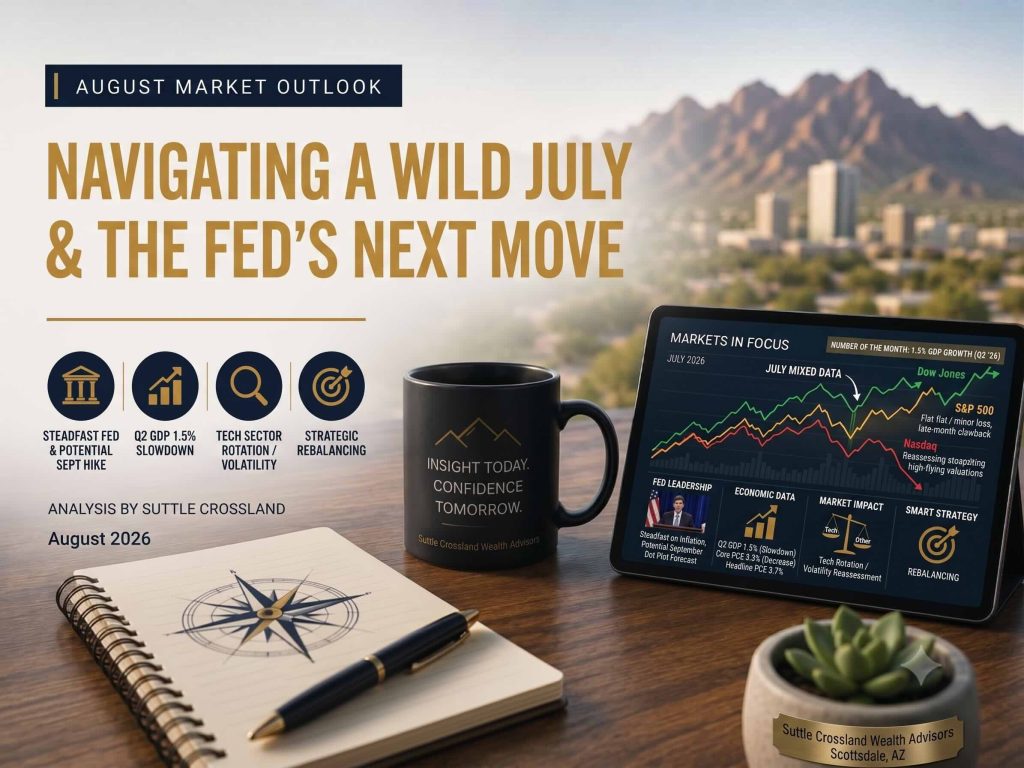
July 2026 proved to be a rollercoaster for financial markets, defined by a dramatic tug-of-war between strong corporate earnings and resurfacing geopolitical and inflation fears. Wall Street experienced significant volatility as oil prices spiked amid Middle East conflict anxieties. This dynamic fueled a rotation beneath the surface of the market, with investors questioning whether the massive artificial intelligence investments that have propelled large-cap technology stocks will quickly translate into profits.
Despite the turbulence, markets managed to claw their way back by the end of the month, driven by resilient corporate profits, notably from tech giants like Amazon. This late-month rally allowed the S&P 500 to narrowly avoid a significant loss, finishing July nearly flat, while the Dow Jones Industrial Average managed to eke out a positive return.
Let’s Get Into the Data
- Economic Growth: The U.S. economy expanded at a sluggish 1.5% annualized pace in the second quarter of 2026, decelerating from the 2.1% growth seen in the first quarter.
- Inflation: The Fed’s preferred inflation gauge, the core Personal Consumption Expenditures (PCE) price index, rose 3.3% year-over-year in June, a slight decrease from May’s 3.4%. Headline PCE inflation, which includes food and energy, rose 3.7% year-over-year in June, down from 4.1% in May.
- Labor Market: Job gains have kept pace with the workforce, and the unemployment rate has changed little, indicating a relatively stable labor market despite the slower broader economic growth.
What Does the Data Add Up To?
The mixed bag of economic data has left the Federal Reserve in a holding pattern. At their July meeting, the Federal Open Market Committee (FOMC) voted to keep the federal funds rate unchanged at a target range of 3.50% to 3.75% for the fifth consecutive meeting. The central bank acknowledged the slower growth but emphasized that economic activity is expanding at a solid pace, buoyed by strong productivity and capital investment.
However, the Fed’s commitment to fighting inflation remains steadfast. Inflation is still running above the central bank’s 2% target, complicated by supply shocks driving up prices in certain sectors, including energy. Notably, three FOMC members dissented from the decision to hold rates, preferring a 25 basis point hike, which keeps the possibility of a rate increase on the table for the September meeting. Fed Chair Kevin Warsh reiterated that the central bank “will deliver price stability” and will “not hesitate to act” to achieve that goal.
Number of the Month: 1.5%
The U.S. gross domestic product (GDP) grew at an annualized rate of 1.5% in the second quarter of 2026. While this represents a slowdown from the previous quarter, it underscores a key principle of long-term investing: markets and economies do not move in straight lines. At Suttle Crossland Wealth Advisors, we emphasize building resilient, tax-efficient financial plans that can weather periods of sluggish growth and market volatility, providing our clients with peace of mind regardless of the short-term economic data.
Market Performance
- Equity Markets in July
- S&P 500: Finished the month down 0.12%, despite a late-month rally driven by strong tech earnings.
- Dow Jones Industrial Average: Managed a positive return, closing the month up 2.5%.
- Nasdaq Composite: Pulled back 2.8% as investors reassessed the valuations of high-flying technology and AI stocks.
- Bond Markets in July
- 10-Year Treasury Yield: The yield on the benchmark 10-year note ended July at 4.75%, an increase from earlier in the month.
- Bloomberg U.S. Aggregate Bond Index: The broader U.S. bond market experienced slight negative returns for the month, dropping 0.28% on the final day of July and ending the month slightly down year-to-date.
Looking Ahead
Investors will be closely watching the upcoming economic data releases in August, particularly the employment report and the CPI and PCE inflation data. These reports will be critical in shaping expectations for the Fed’s next move. Market participants are already looking ahead to the next FOMC meeting scheduled for September 15-16, 2026, where the Fed will also release its updated Summary of Economic Projections (SEP) and Dot Plot.
The Smart Investor
In a market environment characterized by shifting interest rate expectations and sector rotation, it’s crucial to maintain a disciplined approach. This is an opportune time to review your portfolio’s asset allocation and ensure it aligns with your long-term goals and risk tolerance. If the recent volatility has caused your portfolio to drift significantly from its target allocation, consider strategic, tax-efficient rebalancing.
At Suttle Crossland Wealth Advisors, we are committed to helping you navigate the complexities of the financial markets with a fiduciary focus. Contact our team in Scottsdale today to schedule a review and ensure your wealth strategy remains on track.