
Insights

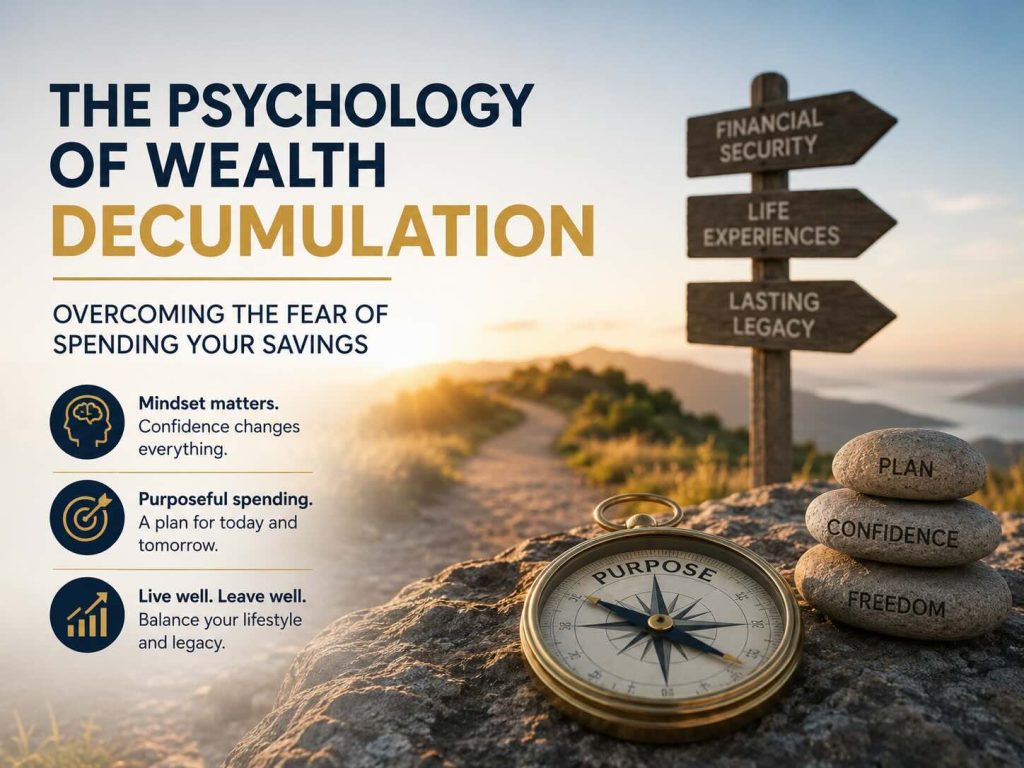
The Psychology of Wealth Decumulation: Overcoming the Fear of Spending Your Savings

The Psychology of Wealth Decumulation: Overcoming the Fear of Spending Your Savings

For decades, the financial industry focuses almost exclusively on one objective: accumulation. You are encouraged to save, invest, optimize your budget, and watch your balance grow. For disciplined savers, this decades-long habit of accumulation becomes deeply ingrained, forming a core part of their financial identity and providing a sense of security.

Then, retirement arrives.

Suddenly, the framework must flip from accumulation to decumulation—the process of purposefully drawing down the assets you spent a career protecting. For many retirees, this transition is one of the most challenging psychological hurdles they encounter. It is common to experience a persistent sense of anxiety when stopping a regular paycheck and starting to draw from a portfolio, even when data and stress-testing show the plan is entirely sustainable.

Understanding the behavioral roadblocks of decumulation is essential to overcoming them, allowing you to utilize your wealth for the purposes you intended.

The Root Causes of “Spending Phobia”

The hesitation to spend down wealth in retirement is rarely a math problem; it is a behavioral economic phenomenon. Several well-documented psychological concepts explain why this shift feels highly disruptive:

  • Loss Aversion: Behavioral research indicates that individuals experience the pain of a loss roughly twice as intensely as the satisfaction of an equivalent gain. In the decumulation phase, seeing a portfolio balance decrease—even when it matches projections—is frequently processed by the brain as a continuous series of financial losses.
  • Mental Accounting: Savers tend to place money into mental categories. For decades, retirement accounts were categorized as “untouchable.” Reclassifying those core assets as “spendable cash flow” requires overcoming significant mental inertia.
  • The “Sunk Cost” of Saving: When you sacrifice current consumption for 30 or 40 years to build a nest egg, that sacrifice represents a massive personal investment. Spending the money can feel like reversing your life’s work, rather than enjoying its reward.

The Hidden Risks of Underspending

While running out of money is a legitimate risk that requires careful planning, chronically underspending carries its own set of consequences. Failing to transition into a decumulation mindset often leads to:

  • Missed Windows of Health: The early years of retirement (often called the “Go-Go years”) represent the period when you are most physically capable of traveling, pursuing active hobbies, and visiting family. Deferring these experiences out of portfolio anxiety can result in missing the window entirely due to later health changes.
  • Unintended Tax Consequences for Heirs: Accumulating an unnecessarily large tax-deferred IRA or 401(k) balance means that, eventually, Required Minimum Distributions (RMDs) will force large distributions at older ages, potentially pushing you into higher tax brackets. Furthermore, leaving massive tax-deferred accounts to non-spouse beneficiaries forces them to withdraw the entire balance within 10 years under current tax laws, often during their own peak earning years, resulting in a heavy tax burden for your heirs.

Three Frameworks to Build Decumulation Confidence

To transition successfully from saving to spending, abstract long-term projections must be replaced with concrete, structural strategies. Here are three methods used to bridge the psychological gap:

1. The Essential vs. Discretionary Floor

Anxiety often drops significantly when you know your basic survival needs are completely covered regardless of market conditions.

  • Establish the Baseline Floor: Map out your essential expenses, such as housing, healthcare, food, and taxes. Ensure these are fully covered by predictable, guaranteed income sources—like Social Security, pensions, or highly secure fixed-income ladders. This structure effectively eliminates the underlying fear of basic resource scarcity.
  • Establish the Discretionary Pool: Once your “floor” is secured, you can view your remaining equity and growth portfolio strictly as a tool for lifestyle expenses, such as travel, hobbies, and gifting. This allows for guilt-free spending. If the market experiences a prolonged downturn, you may choose to temporarily scale back on these discretionary items, but you maintain the peace of mind that your home and healthcare are never at risk.

2. Re-Creating the Cadence of a Paycheck

Receiving a large lump-sum distribution once a year can feel destabilizing because it highlights the reduction in your portfolio balance. To counteract this, automate your income distributions. Work with your advisor to set up an automated monthly or bi-weekly transfer from your investment account to your checking account, matching the timing of your previous salary. This structured cadence helps re-establish a sense of financial normalcy.

3. Defining Your “Legacy vs. Lifestyle” Mandate

Clearly separate the money meant for you from the money meant for others. If a portion of your wealth is earmarked for children, grandchildren, or charity, segment those accounts visually and legally. Knowing exactly which dollars are designated for your legacy allows you to view the remainder of the portfolio as capital that is explicitly intended to be spent down to zero during your lifetime.

A Structural Approach to Peace of Mind

A comprehensive retirement plan is more than an asset allocation model; it must align with human behavior. At Suttle Crossland Wealth Advisors, our role as fee-only fiduciaries extends beyond managing investments. We provide the analytical framework, tax optimization, and stress-testing necessary to transform a pool of savings into a reliable, lifelong cash flow system.

Your wealth is a tool designed to fund your life, your values, and your transitions. If you are preparing to retire and want to establish a distribution strategy that balances tax efficiency with personal peace of mind, contact our team in Scottsdale today to schedule an introductory consultation.

For decades, the financial industry focuses almost exclusively on one objective: accumulation. You are encouraged to save, invest, optimize your budget, and watch your balance grow. For disciplined savers, this decades-long habit of accumulation becomes deeply ingrained, forming a core part of their financial identity and providing a sense of security.

Then, retirement arrives.

Suddenly, the framework must flip from accumulation to decumulation—the process of purposefully drawing down the assets you spent a career protecting. For many retirees, this transition is one of the most challenging psychological hurdles they encounter. It is common to experience a persistent sense of anxiety when stopping a regular paycheck and starting to draw from a portfolio, even when data and stress-testing show the plan is entirely sustainable.

Understanding the behavioral roadblocks of decumulation is essential to overcoming them, allowing you to utilize your wealth for the purposes you intended.

The Root Causes of “Spending Phobia”

The hesitation to spend down wealth in retirement is rarely a math problem; it is a behavioral economic phenomenon. Several well-documented psychological concepts explain why this shift feels highly disruptive:

  • Loss Aversion: Behavioral research indicates that individuals experience the pain of a loss roughly twice as intensely as the satisfaction of an equivalent gain. In the decumulation phase, seeing a portfolio balance decrease—even when it matches projections—is frequently processed by the brain as a continuous series of financial losses.
  • Mental Accounting: Savers tend to place money into mental categories. For decades, retirement accounts were categorized as “untouchable.” Reclassifying those core assets as “spendable cash flow” requires overcoming significant mental inertia.
  • The “Sunk Cost” of Saving: When you sacrifice current consumption for 30 or 40 years to build a nest egg, that sacrifice represents a massive personal investment. Spending the money can feel like reversing your life’s work, rather than enjoying its reward.

The Hidden Risks of Underspending

While running out of money is a legitimate risk that requires careful planning, chronically underspending carries its own set of consequences. Failing to transition into a decumulation mindset often leads to:

  • Missed Windows of Health: The early years of retirement (often called the “Go-Go years”) represent the period when you are most physically capable of traveling, pursuing active hobbies, and visiting family. Deferring these experiences out of portfolio anxiety can result in missing the window entirely due to later health changes.
  • Unintended Tax Consequences for Heirs: Accumulating an unnecessarily large tax-deferred IRA or 401(k) balance means that, eventually, Required Minimum Distributions (RMDs) will force large distributions at older ages, potentially pushing you into higher tax brackets. Furthermore, leaving massive tax-deferred accounts to non-spouse beneficiaries forces them to withdraw the entire balance within 10 years under current tax laws, often during their own peak earning years, resulting in a heavy tax burden for your heirs.

Three Frameworks to Build Decumulation Confidence

To transition successfully from saving to spending, abstract long-term projections must be replaced with concrete, structural strategies. Here are three methods used to bridge the psychological gap:

1. The Essential vs. Discretionary Floor

Anxiety often drops significantly when you know your basic survival needs are completely covered regardless of market conditions.

  • Establish the Baseline Floor: Map out your essential expenses, such as housing, healthcare, food, and taxes. Ensure these are fully covered by predictable, guaranteed income sources—like Social Security, pensions, or highly secure fixed-income ladders. This structure effectively eliminates the underlying fear of basic resource scarcity.
  • Establish the Discretionary Pool: Once your “floor” is secured, you can view your remaining equity and growth portfolio strictly as a tool for lifestyle expenses, such as travel, hobbies, and gifting. This allows for guilt-free spending. If the market experiences a prolonged downturn, you may choose to temporarily scale back on these discretionary items, but you maintain the peace of mind that your home and healthcare are never at risk.

2. Re-Creating the Cadence of a Paycheck

Receiving a large lump-sum distribution once a year can feel destabilizing because it highlights the reduction in your portfolio balance. To counteract this, automate your income distributions. Work with your advisor to set up an automated monthly or bi-weekly transfer from your investment account to your checking account, matching the timing of your previous salary. This structured cadence helps re-establish a sense of financial normalcy.

3. Defining Your “Legacy vs. Lifestyle” Mandate

Clearly separate the money meant for you from the money meant for others. If a portion of your wealth is earmarked for children, grandchildren, or charity, segment those accounts visually and legally. Knowing exactly which dollars are designated for your legacy allows you to view the remainder of the portfolio as capital that is explicitly intended to be spent down to zero during your lifetime.

A Structural Approach to Peace of Mind

A comprehensive retirement plan is more than an asset allocation model; it must align with human behavior. At Suttle Crossland Wealth Advisors, our role as fee-only fiduciaries extends beyond managing investments. We provide the analytical framework, tax optimization, and stress-testing necessary to transform a pool of savings into a reliable, lifelong cash flow system.

Your wealth is a tool designed to fund your life, your values, and your transitions. If you are preparing to retire and want to establish a distribution strategy that balances tax efficiency with personal peace of mind, contact our team in Scottsdale today to schedule an introductory consultation.